Saturday, August 2, 2014

Reptiles: Up Close

It all started when I took Gordon Lee to Petsmart to see some reptiles.  I figured that would be a nice way for him to see in person what these reptiles he's been reading about are like.  Then he asked me.
"Mommy, do they have alligators or crocodiles here?"
"No, Gordon Lee, Petsmart does not sell crocodiles and alligators."

Then I thought, hmmm I wonder if there is some place around here to see alligators.  Alligators do live in Georgia.

So, I googled, alligators in our own town. It directed me to the website of a place called Oxbow Meadows whose main claim was their alligators.  Perfect! I didn't see any prices on the website.  I called the next day.  The nice lady told me that their large alligators were not there right now as their habitat was being cleaned.  However, they did have baby alligators that we could see if we would like to.  She also told me that everything was free.

So we went!
While they have many reptiles, they also have numerous other educationally-rich things.  They have insect exhibits, amphibian exhibits, they have a whole section for honey bees.  They have a rain garden and information about being resourceful with water.  They have a bird sanctuary.  All viewable for free!

First, they brought us to the back to see their baby alligators.  They were adorable! They were hungry and snapping, though, so they stayed in their "pool" as Gordon Lee called it.


Next, we moved on to see a variety of snakes. 

This rat snake came right up to the glass to say "hello" to Gordon Lee.  He was excited to see the snake using its tongue to smell.  But he didn't trust the glass, and he didn't want to get too close.

We learned about the anatomy of turtles/tortoises
We saw quite a few turtles and tortoises.
This is an adorable little tortoise called a "gopher tortoise" because it likes to go under the ground.  I almost wanted one for myself...until we saw a larger one in a bigger habitat. 
Outdoor turtle pond.
We saw some large tortoises outside.  I didn't see the sign that told us what kind they were.  However, upon researching it, I believe this is called the African spurred tortoise.

We truly had an excellent time.  Gordon Lee learned a ton about the animals in his books. It was definitely a very kid friendly place.  They had these great viewing step stools for children to get a better view at the habitats.  Pictured below is Gordon Lee using one to see down into the Burmese Python's water hole.
You never know what fun things you can find until you go looking for them! We will certainly return for more learning experiences (and to see the full-sized alligators when they return)!

Friday, August 1, 2014

Simple Reptile Crafts: Turtle and Snake (Mess-free and easy)

This week, Gordon Lee did two art activities to have fun with learning about reptiles.  The first activity was really just my own idea--making a turtle out of construction paper.  However, Gordon Lee added on his own creative adaptation to it! The second one I found while googling "snake crafts."

Turtle
These are the only 2 pictures I have of Gordon Lee's turtle.  While we were making it, I was busy getting everything together and didn't think to take pictures.

So to explain how we did this, I just made another one of my own.

1.) Two pieces of construction paper--I chose green and brown paper because you use practically the entire sheet of green, and I think brown compliments the green well.
2.) I traced one of Gordon Lee's plates to make the circle.  It's about the size of a dessert plate.

3.) With the rest of the green paper, I cut out 1 head, 4 legs, and 1 tail.  I just eyeballed these. Basically, I just tried to make the head and legs look like giant thumbs.

4.) Then I drew symbols on the green piece of paper to show Gordon Lee where to glue the pieces.  Honestly, though, you could probably just draw an X on every one because it is a circle anyway.  So, I drew symbols at 12, 10, 20, 30, 40, and 50.
 5.) Gordon Lee glued the pieces to the symbols.  It makes it much easier for him.
 6.) I asked Gordon Lee which side he wanted to be the turtle's top shell and he said brown.  I like his choice.  He then wanted to "paint it." So he added green paint to the brown shell of his turtle.
 7.) We then drew 2 dots for eyes.  Here's where Gordon Lee adapted it.  He had the idea to fold the head and legs to "tuck him into his shell." Then, together we saw that you could also make him look like he is walking by pulling the legs out and bending the head up.

We had fun with it!

Snake Craft
This one I found online.  Tip: When I told Gordon Lee to "glue each X and then stick them together," he kept making the tear-drop shape with each loop.  But when I said, "Make the x's touch," he completely understood and was able to make a loop.
I allowed Gordon Lee to choose the color he wanted for his snake.  He wanted it to be white.

1.) I laid the white piece of construction paper out horizontally, and I used a ruler to cut out however many strips I could get.  I think I should have made smaller strips, but this is the size I made.
2.) I drew one ex on opposing ends and sides where Gordon Lee was to glue. 

3.) I saved one loop. I cut the ends to a point and drew x's on the same side on each end for the head.
4.) I cut a small tongue out of red paper.

5.) Gordon Lee started gluing.  This is where I told him to make the x's touch each other.

6.) When all of the loops were finished, we made the head. Gordon Lee glued each x.  We stuck the tongue on one of them.  Then he folded one end over to make them touch.

7.) So, the head should only have glue where the X is.  This leaves the base free.  To fold a flat part.  You glue the flat part and then stick it to any loop.

And the snake is done! Gordon Lee didn't even bother putting eyes on this one.  He just wanted to make it slither and move around like a snake.


Sunday, July 27, 2014

Disappearing Act

Today, we did an experiment to see what things dissolve in water and what things don't. 

First, I said, "Okay, Gordon Lee, we are going to learn a new word today.  It is called dissolve. Can you say dissolve?"
He replied, "dissolve"
Then I said, "Dissolving is like mixing.  When something dissolves into water, it mixes with the water.  It becomes part of the water.  Let's see what things dissolve in water!"

So, I placed a tray with six small cups of water in front of him (I had this from my baby bullet set for freezing food).
Then, I chose 6 items for our experiment (leftover construction paper squares from yesterday, a graham cracker animal cookie, an ice cube, food coloring, a candle, and a chewable tablet for nausea)
We placed each item in its own cup.  I gave Gordon Lee a spoon to see if he could help dissolve some of the items.  He really enjoyed this!


He quickly understood the concept of dissolving as he saw that..
1.) The food coloring dissolved immediately.
2.) The ice cube and the graham cracker dissolved very quickly.  I took a minute to remind him that the ice cube was water, but it was just frozen.
3.) He was a little confused as to why the chewable tablet was taking a long time to dissolve.  I warmed up some water in a different cup and showed him how it dissolved faster in warm water.
4.) And he saw that the construction paper and the wax candle clearly did not dissolve at all.

He clearly understood what it meant and enjoyed experimenting with it.  However, he asked me a question at the end that I found myself unable to answer.

"Mommy, why didn't the candle and the paper dissolve?"

Oh gee...I wasn't prepared for that one.  So, I sort of gave the best answer I could.  "Well, Gordon Lee, they are just solids that don't dissolve in water!"

Saturday, July 26, 2014

Creating a Mosaic and Finding Patterns

I shouldn't make promises I can't keep.  In the last blog I wrote, I had said that the next day I'd share another blog about a book Gordon Lee and I were reading and a water activity that we did.  Well, Gordon Lee was having mood swings the "next day," and we didn't get much accomplished.  We did learn about how rain that has fallen turns into water vapor and returns to the sky to form clouds.  Gordon Lee made an observation on a poster that showed the cycle, and he has been paying closer attention to the clouds in the sky.  Other than that, he was just oppositional to anything and everything for the day.  I wasn't about to plan any activities with him or they'd probably get thrown all over the floor in a fit of rage.

Today was much better.  So, we accomplished a mosaic activity, which is very simple. I just cut several squares from two different shades of blue construction paper.  I gave Gordon Lee a sheet of white construction paper.  And I told him to create any kind of water that he wanted to. 
I put both colored squares in a cup together.
I gave Gordon Lee a glue stick, a blank sheet of paper, and let his imagination take over.  He said he was making "An ocean with a waterfall" (interesting concept!).
At first, he seemed to be placing squares randomly on the paper.
I left him to his own devices while I got a few other things done (in the end he ended up spending at least 30 minutes gluing and sticking).  I came to check on him after a few minutes, and I saw that he was starting to create his own shape (a circle appeared to be forming).
I checked on him again several minutes later and indeed a circle was forming.  He also appeared to be filling it in.
All of this took him a good 30 minutes.  After awhile, any child will get tired.  Plus, we did this right before his nap time.  After taking his nap, the first thing he said when he woke up was, "I want to finish my picture, Mommy!" He returned to it to add some more squares.  He took another break.  He came back to it later in the evening when he made his announcement that he was "all done." 
This is the final product of "Ocean with a Waterfall" by Gordon Lee

Overall: 
1.) This is an easy art activity (that creates very little mess..just a little bit of glue on the fingers).
2.) It kept Gordon Lee busy and engaged in something meaningful for him.
3.) He was extremely pleased with this own masterpiece.

Funny thing--we wouldn't have been able to accomplish this yesterday. Those squares would have been all over the floor.  Regardless of what we are doing with him, no child is perfect.  No day is perfect. Sometimes, you plan things and just have to wait to do them.  Interesting how something that is a success in one day may not have been for another day. 

Now onto the book.  One of the books that we have been reading was one that I put on the list because I was having a hard time finding enough fictional books (and I wanted one on rain).  
Two people judged it by its cover.
Me: I thought "This book just looks boring.  It looks like it might be about a baboon named rain!"
Gordon Lee: "I want to read this one! There's a monkey on the cover!"
It's called Rain by Manya Stojic, and it is an adorable story with a lot of elements for building early literacy.

One element is a pattern of prediction.  Gordon Lee quickly and easily picked up on the fact that the animals were each using one of the 5 senses to detect rain.  Then, each animal tells another animal about the rain.  So, he started predicting what was going to happen next (a very important skill for active, engaged readers).  It all starts early!

Another element is the pattern of rain.  The soil is dry and cracked at the beginning of the story.  
Then the story starts with a porcupine sensing the rain solely through smell.

The chain begins.  Each sense used detects the rain as it gets closer and closer.  Each page builds on the previous ones.  Reminding the reader of the pattern.
The last animal to detect the rain is a lion who tastes it on his tongue.  Then, the rain pours down.  The book shows how it has impacted the scenery.  Gordon Lee likes to point out two things on this page every time, "There's a grasshopper in this book! This is a buggy book too!" and "Somebody colored on this page.  They shouldn't do that to a library book!" (There is a brown crayon scribble.  I am not sure how well it shows up in this picture).
After this point, the animals use their senses again "To feel the squishy mud, to taste water that has pooled, to enjoy the shade of the leaves, etc."  The book is cyclical and comes back to the point it started where the porcupine announces she knows the rain will return again.

Gordon Lee "read" this book to his Nana R on the phone tonight and he actually recited 1-2 sentences verbatim from each page.  It's amazing how much a child absorbs.  

I'd highly recommend this book.  It is cute and educational (in so many ways) at the same time!

Thursday, July 24, 2014

Learning by Exploring

Since I will be staying home with Gordon Lee again for the next several months, I have felt the need to enrich himself and myself in this time.  I feel like I just can't stay away from teaching, and I also want to make sure that Gordon Lee is engaged in something that is going to expand his thinking.  So, an idea formed.  I can't take complete credit, so I will explain the process of this idea.

1.) The local library where my mother lives started creating backpacks of books on various topics.  She had checked one out on digging in the dirt.  It came complete with a small shovel, magnifying glass, and other dirt-exploring fun. There was a nice variety of books to help a child understand soil better (The beginning of my idea).

2.) While I worked with preschoolers, I was introduced to the Creative Curriculum.  The approach of the creative curriculum is to encourage children to explore through their own natural curiosities, to enhance those curiosities, and to consequently provide the most enriching educational experience for a child.  When I first saw it, I was skeptical.  It seemed so empty (unlike some other curriculums that had a specific structure in each unit).  The approach is to take a unit of study and spend 3-4 weeks exploring the topic in every possible way. From my personal experience with 3-year-olds, I found that the only downside to the curriculum was the amount of time spent on one topic.  They could only sustain a heightened interest in the topic for about 2 weeks before it became too repetitive for them.  Ultimately, it sort of backfired on itself because they wouldn't want to talk about the topic at all anymore after the last week.  So, I thought, good idea.  I like the exploration approach.  Let the child ask questions.  Help the child make observations.  Link understanding to early literacy and reading (which is what the curriculum is rooted in).  Just shorten it so they don't get exhausted by it.

3.) Here's the result.  Create our own "book bag" on a topic (especially since our library here doesn't have them).  Then, incorporate the Creative Curriculum approach into our study.  I choose one topic for us to explore.  I look up 10 books to put on hold at the library (making sure they are children's books).  I try to keep a good variety of fiction and nonfiction.  Then, we take our bag to the library and we fill it up.  Gordon Lee loves putting the old books in the return slot.

We basically do anything and everything with the topics.  We are on our second week.  The first week, we explored bugs.  This week, we are learning all about water.  Next week we are going to discover reptiles (and I am particularly excited about this one since Gordon Lee asked me for an iguana at Petco the other day).  

You start finding that you don't have to go out and spend a bunch of money to provide a very meaningful experience for a child.  Just a trip to the pet store can show them so much.  Even this week with water, God helped us out by giving us rain for 4 days.  So, Gordon Lee and I stood outside of the YMCA one day watching rainwater wash down a pipe and into the parking lot.  He observed how the hill helped the water run away from the building, and then realized that the giant puddles he liked jumping in formed because the parking lot was a flat base where the water could pool.  Now he is constantly finding drains and looking to see where the water is going.

And while we've moved onto a new topic, he is still excited about last week's topic and still expanding his knowledge.  He found a dead Japanese beetle, picked it up and discovered why a beetle is a beetle (due to the wing covers).  This is my child who would freak out at the sight of any bug before this.  He started learning about them and understanding that not all bugs bite or sting.  Yesterday, he became extremely excited at the sight of a grasshopper. He wanted to see how the grasshopper moved and how it could fly.

We also did a lot of art during our bug week.  Here are just a few samples.  Gordon Lee wanted to draw, paint, color, or make every bug.
(bumblebee with wax paper wings)
(spider in a web made with the palm of his hand, his 4 fingers, and just free-handing the head)
(butterfly--of course..I did draw those antennae.  He did the rest)

I could go on and on about how excited he is, how much I am learning, how much he is learning, and how readily books are expanding his observations around him.  However, I will stop here. I will start sharing one fun thing we did each day plus sharing one book I particularly like from the selection we're reading.
For the bug unit, here are some of the books Gordon Lee loved.
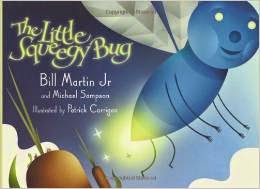
The Little Squeegy Bug by Bill Martin Jr.
This is a cute fictional story about a bug that has no identity. So, they all call it a little squeegy bug.  He just wants to feel special and fly in the sky.  Ultimately, a magic spider turns him into the firefly.

Bug Safari by Bob Barner
This is a story about a child who follows an army of ants to an unknown destination.  Meanwhile on their journey, he learns about all of the struggles a tiny ant faces in the big world of bugs.  Gordon Lee requested this one every single day.
This is just a sample of the nonfiction bug books we got.  We had 5 of them.  They are from a series called "Bugs, Bugs, Bugs!" by Margaret Hall.  We had grasshoppers, fireflies, beetles, bees, and centipedes.  These were extremely educational, and even I learned things I didn't know.

As for water, we are not doing as much art, we are doing more experiments and observations. Tomorrow, I will share one of my favorite (and Gordon Lee's favorite) books on water.  Admittedly, I judged this book by its cover and didn't want to read it, but then I loved it.  And I will share one of our water activites.